
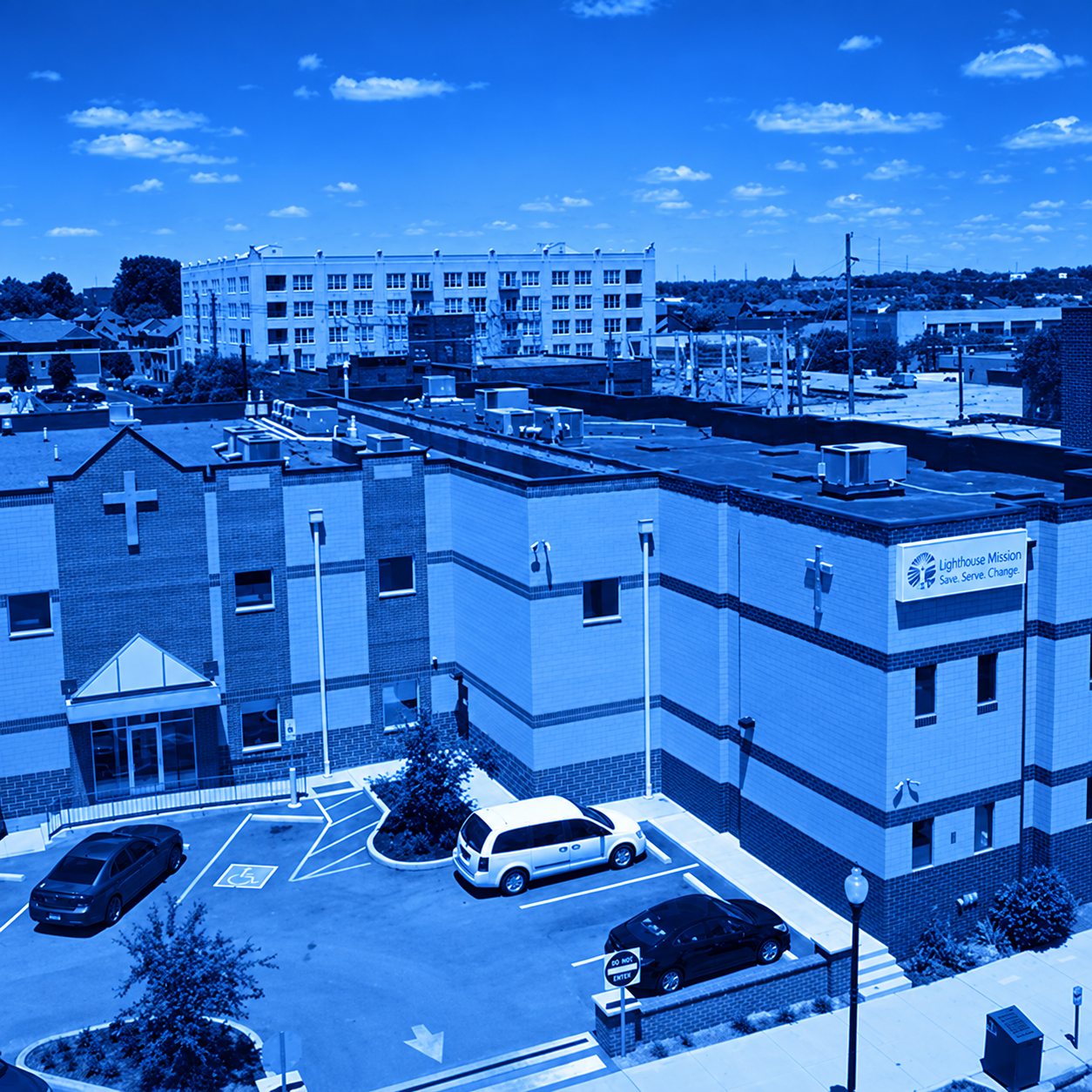
By the time Indianapolis became my playground, Lighthouse Mission had become the place where I returned every night. It was where I slept, showered, kept my duffel bag and learned the peculiar choreography of living in a building with roughly two hundred other men who had all arrived there by different roads. The seventh floor held about a hundred bunk beds. Downstairs, another hundred men could sleep on mats. My room alone held somewhere around seventy-five people, packed close enough that the distance between my bed and another man's life could be measured in feet.
During my first week there, I barely slept. Privacy was mostly a memory from another life. There were coughs in the dark, snoring, conversations that refused to end, men getting up to use the bathroom, men returning to their bunks, bodies turning beneath blankets and all the ordinary sounds that become enormous when seventy-five people are trying to sleep in the same room. I kept my duffel bag close enough to use as a pillow because everything I owned that mattered was inside it. I had entered a world with its own rules, schedule, language and hierarchy, and for those first nights I understood almost none of it. Eventually, even chaos develops a rhythm.
Breakfast came around eight. At nine, the gates opened and those of us who weren't enrolled in one of the Mission's programs had to leave. We could return around noon for about an hour, then leave again until dinner around five. Members of the public came through for meals too. After dinner, the gates eventually closed for the night, usually somewhere around six, and the building settled into whatever passed for evening among a couple hundred men with nowhere else to go. That schedule became one of the reasons I learned Indianapolis so intimately. Lighthouse gave me a bed at night and then released me into the city every morning with hours to fill and almost no obligations beyond showing up for my part-time shifts at the hotel front desk a couple blocks away.
Most mornings I cleaned myself up, put on some cologne, threw my backpack over my shoulder and put my headphones on before walking through the Mission doors. Music was with me almost constantly. Dave Matthews Band, Jack Johnson, hip-hop playlists I had assembled myself, whatever fit the particular mood of that morning. I walked toward Monument Circle, the canal, White River State Park and IUPUI. I carried my notebook and wrote religiously. Once I had the Motorola RAZR, I took pictures too, fascinated by the simple ability to freeze a little piece of the city and carry it around with me. I smoked cigarettes, kept my Zippo in my left pocket and wandered through Indianapolis with maybe twenty dollars in my wallet on a good day.
As the weeks passed, I also started getting to know the men I returned to every night. Before Lighthouse, homelessness was something I understood mostly from the outside. I had seen people standing at intersections with cardboard signs and passed people sleeping on benches. I knew the familiar explanations people attached to them: addiction, mental illness, laziness, criminality, bad decisions. Then I began sleeping a few feet away from the people those words were supposed to explain, eating beside them, smoking cigarettes with them and listening to what had happened before they ended up inside the same building as me.
There were addicts at Lighthouse, plenty of them. There were men with mental illnesses that were obvious within minutes of meeting them and others whose illnesses remained hidden behind surprisingly ordinary conversations. There were men who had burned every bridge available to them, men running from warrants, ruined marriages, child-support obligations and debts, and men who had made decisions so destructive that even they struggled to explain how their lives had reached this point. I also met men whose lives seemed to have collapsed one piece at a time. A job disappeared. Rent went unpaid. A marriage ended. A medical problem made work impossible. Family relationships fractured. Pride kept someone from asking for help until there was nobody left to ask. Every bunk had a biography, and I became curious in hearing them.
A JOB DISAPPEARED
RENT WENT UNPAID
A MARRIAGE ENDED
HEALTH FAILED
FAMILY FRACTURED
THERE WAS NOBODY LEFT TO ASK
TWO HUNDRED MEN · TWO HUNDRED ROADS HERE
I was twenty-four years old and carrying enough wreckage of my own to fill a room, yet suddenly I was surrounded by men whose lives contained whole worlds I had never imagined. Some were twice my age. Some had children they hadn't seen in years. Some had once owned houses, managed businesses, served in the military, worked trades or raised families. Others had been moving between institutions, shelters, couches, jails and streets for so long that stability had become something they remembered more easily than something they could imagine reaching again. Living among them began changing the way I looked at people because I could finally see how much history disappears when someone's entire identity gets reduced to his present circumstances.
There were also some unbelievable characters in that building. I could probably write an entire series about the men I met at Lighthouse, and someday I may. Some were hilarious. Some were exhausting. Some could turn a cigarette break into a forty-minute monologue, and others carried themselves like mayors of an invisible city, somehow knowing everybody, every rule, every shortcut and every piece of gossip before breakfast was over. Friendships formed quickly because we were living on top of one another. So did arguments and alliances. There were men you learned to trust, men you learned to watch and men whose stories became a little more impossible every time they told them.
At night, whatever identities we had carried through the rest of our lives came back through the same doors. A businessman could sleep twenty feet from an addict. A veteran could stand in the same meal line as a kid who had spent most of his adult life getting high. Someone with a college education could share a bathroom with someone who could barely read. Somewhere among all of them was me, trying to figure out who Andrew Barrett was going to become when so much of what had previously defined my life had fallen away.
I had almost nobody then. My relationships with family were shattered or distant, and I didn't have a meaningful circle of friends waiting somewhere else in Indianapolis. There was no house I could drive back to on Sunday afternoon, no familiar bedroom preserved for me and no dependable safety net waiting underneath me. My life had been stripped down until most of what remained could fit into a duffel bag and backpack. That reality could be frightening, especially at night when I thought too long about what would happen if the Mission stopped being available to me.
During the day, though, the emptiness in my life created a kind of freedom I had rarely experienced. Nobody needed to know where I was going when I walked out the doors in the morning. Nobody was waiting for an explanation when I returned. I could walk for miles or sit beside the canal for hours with my notebook. I could drift toward IUPUI and spend time around people approximately my age. I could put on my headphones and let Indianapolis become the soundtrack to itself. For most of my earlier life, so much of my attention had been consumed by other people: wanting something from them, disappointing them, fighting with them, hiding from them, trying to impress them or desperately wanting them to see me differently. During that summer, there were long stretches when nobody was watching me at all. I began discovering what I did when the audience disappeared.
I WALKED
I LISTENED
I WROTE
I TOOK PICTURES
I PAID ATTENTION
I WAS BEGINNING TO MEET MYSELF
I walked. I listened. I wrote. I took pictures. I sat still long enough to notice things. The city became familiar through repetition, until streets that had once belonged to strangers started carrying my own memories. Certain benches became places where I wrote. Certain corners reminded me of conversations. The Circle, the canal, White River State Park and the streets around IUPUI slowly became coordinates in a private map I was drawing inside myself. I had no idea that twenty years later I would be sitting here trying to reconstruct that young man's world and wishing I could reach backward through time to ask him questions.
More than anything, I wish I still had his notebooks. I want to know what I wrote while sitting beside the canal. I want to know what frightened me, what I believed would happen next and which men from Lighthouse I thought I would remember forever. Writing has followed me through so many versions of my life that I wonder now whether I was already doing then what I am doing with Prism of a Life today: trying to capture enough of a moment that some part of it might survive me moving on from it.
There is a photograph in my memory that no camera ever took. I am twenty-four years old, walking through downtown Indianapolis with a backpack on my shoulders and headphones over my ears. Cigarettes are in one pocket and my Zippo is in the other. There might be twenty dollars in my wallet. I have nowhere of my own to sleep that night, and when evening comes I will walk back toward Lighthouse Mission, pass through the doors and climb into a bunk surrounded by dozens of other men.
I remember feeling alive.
I can say that now without turning homelessness into something beautiful. The Mission was crowded. Living there could be exhausting. I had almost no money and very little security. I was living inside circumstances that could become dangerous quickly, and there were consequences waiting farther down the road that I couldn't yet see. Still, I remain grateful for parts of that summer. I am grateful for the miles I walked, for the notebook I carried, for the photographs I took and especially for the men whose lives briefly intersected mine.
They taught me how easily a person's worst season can swallow everything that came before it. Once someone becomes "the homeless guy," the rest of his biography can disappear from view. The men around me were fathers, husbands, sons, veterans, laborers, managers, addicts, victims, criminals, friends, believers, liars and survivors, often carrying several of those identities at once. Their lives were messy and contradictory because human lives are messy and contradictory. The longer I stayed at Lighthouse, the harder it became to believe that a single word could tell me very much about the man sleeping in the bunk beside me.
A HUMAN LIFE COULD HOLD ALL OF THEM
My own life should have made that obvious. The twenty-four-year-old walking around Indianapolis in the summer of 2006 carried things nobody passing me on the sidewalk could have known. Addiction was already part of my history. Mental illness was moving through my life without a name. I carried anger, shame, loneliness, impulsiveness and an enormous hunger to belong somewhere. I was also curious about the world. I could be tender. I loved music deeply. I paid attention to people. Somewhere inside that backpack was a notebook belonging to a writer who hadn't yet figured out what writing might eventually mean to him.
By late summer, I had begun imagining what would come next. I understood that I couldn't spend my life walking from Lighthouse Mission to Monument Circle and back again. I needed work, stability and some kind of future. For a while, I began building one. The months that followed would eventually carry me into some of the darkest territory of my twenties. Crack cocaine would enter the story. There would be violence, an assault and a situation involving someone in leadership at Lighthouse that I understand very differently at forty-five than I did at twenty-four. Eventually I would be kicked out. Years later, I would return to Lighthouse Mission again and enter its year-long recovery program.
Those stories deserve room of their own, because reducing them to a few dramatic paragraphs here would flatten another complicated chapter of my life. This story belongs to the summer before all of that, when I could still walk out the Mission doors each morning and see an entire city waiting for me. It belongs to the men sleeping a few feet away, each carrying a history too large to fit on a bunk. It belongs to grainy photographs, an old Motorola RAZR, headphones, cigarettes, a Zippo, a backpack and notebooks I desperately wish had survived.
Twenty years later, I understand why I keep returning to those months. I possessed almost nothing, and nearly everything important to me could fit inside the bags I carried. Indianapolis gave me miles of room to wander while I was trying to understand what came next. Lighthouse gave me a temporary place to return to and introduced me to people whose stories permanently complicated the way I see homelessness, failure and the long series of events that can bring a human being to the edge of his life.
Block by block, I learned Indianapolis.
Man by man, I learned something about people.
Mile by mile, I was beginning to learn myself.
Of course, this was before the betrayal. Before the assault on the man who would hold me captive. Before Lighthouse would throw me out onto the streets. Before I would eventually walk back through those same doors and begin changing the trajectory of my life.
But all of that was still waiting for me on the other side of summer.